





Early Morning Quake in Johor Bahru
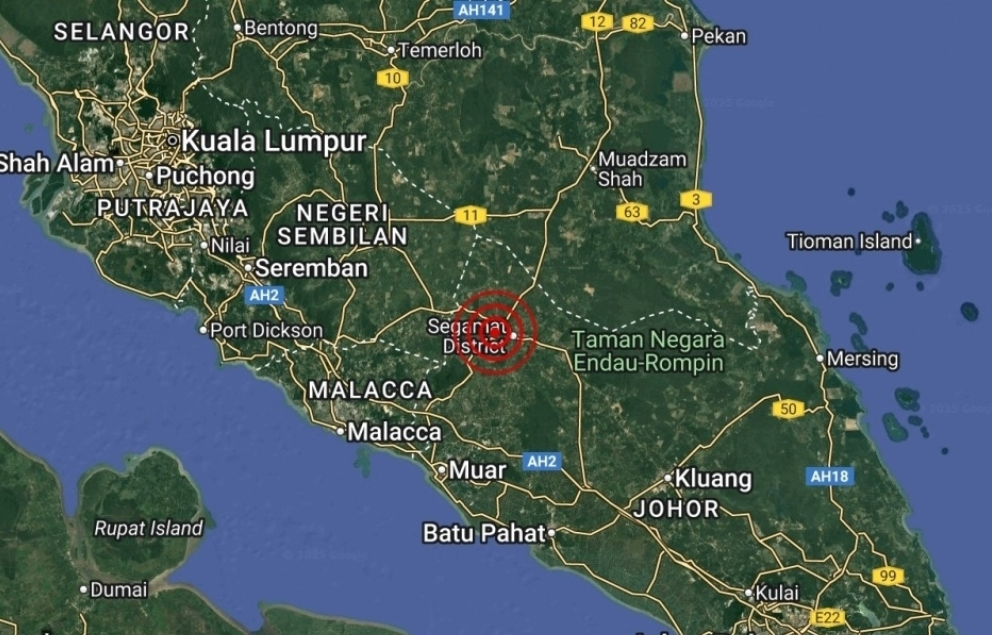
On Sunday, Aug 24, the usually calm Malaysian state of Johor woke up to an unusual natural event. At exactly 6.15am, a 4.1-magnitude earthquake struck 5km west of Segamat at a depth of 10km, according to the Malaysian Meteorological Department (MetMalaysia). In a Facebook post, the department said the quake occurred without warning, shaking the town and nearby areas.
People in Johor Bahru and surrounding states including Negeri Sembilan, Melaka, and southern Pahang reported tremors. Many residents felt the ground move, while some described a loud sound echoing before the shaking started.
Panic and Reactions of Residents
For many, the experience was frightening. Some residents reported panic after hearing a sudden loud bang. Closed-circuit television cameras captured footage of vehicles shaking, with several car alarms triggered by the vibration.
Not long after, at 9am, a second, milder 2.8-magnitude quake was recorded at the same epicentre, located about 28km northwest of Kluang. While there was no tsunami threat, MetMalaysia confirmed they would monitor the situation and continue updating the public.
Authorities and Government Response
The Chief Minister, Onn Hafiz Ghazi, urged the public to remain calm. He stated there were no reports of accidents, property damage, or injury in the morning incident. The government assured that monitoring efforts were ongoing with relevant agencies, asking people to heed instructions especially if living near unstable structures.
On social media, particularly local groups, minor cases surfaced. According to The Star, some people escaped injury when ceiling plaster collapsed inside a prayer hall in Kampung Sanglang. The imam recalled hearing a loud bang before crashing pieces of plaster fell.
In Komuniti Segamat, photos showed cracks in a home at Kampung Tengah, where politician Jimmy Puah confirmed fallen debris. Local agency Bernama reported that a resident at work suddenly felt his office shook, and a photo shared online showed a family standing outside, ready in case the house collapse.
A 32-year-old resident, Nur Hafiz Mukmin, said his wife and child were panicked, while their neighbour Ms Normala Mohamed described how glass panels violently shook in the kitchen, leaving her worried about unexpected aftershocks.
Others also shared stories online. FarisMohdKhir posted on X that he was sleeping when the noise woke him, thinking a plane crashed nearby. On Reddit, a user narevaris compared it to a lorry smashing into the ground, waking him instantly.
credit:malaymail.com/
Safety of Key Infrastructure
Concerns quickly spread about whether essential infrastructure was affected. In a statement, Malaysia’s national oil and gas company, Petronas, confirmed that its pipeline facilities in the Southern Region were not harmed. Their regional teams carried out immediate safety protocols, checking the compressor station, control points, and right-of-way areas.
The company explained that no abnormalities, disruptions, or detected pressure changes were found. Operational parameters remained stable, and they were in active communication with authorities while providing ongoing updates.
Why Earthquakes Are Rare in Malaysia
By Aug 25, reports from Kuala Lumpur highlighted that earthquakes in Malaysia are a rare natural phenomenon. Due to its geographic location and geological makeup, the country is generally considered quake-free. However, as experts note, exceptions exist.
While Malaysia is not on the Pacific Ring of Fire, which is a major tectonic belt filled with volcanoes, it lies near the Sunda Shelf and surrounding Ocean regions. These areas hold fault zones that can be stressed enough to generate seismic activity. Research published in the Journal of Asian Earth Sciences (2019) pointed to hidden fault lines across the borders of the region, showing Malaysia is capable of experiencing small-scale quakes.
Most quakes that register in Peninsular Malaysia, Sabah, or Sarawak are minor and of low magnitude, usually ranging from 2.0 to 4.0 on the Richter scale. However, history shows that large-scale destructive events are not entirely exempt from Malaysia’s existence.
Notable Earthquakes in Malaysian History
To understand the risk, it helps to recall the past events. On June 5, 2015, the Sabah Earthquake struck Ranau with a 6.0 magnitude at Mount Kinabalu. It lasted about 30 seconds and left 18 deaths, along with widespread damage that forced the mountain to close for climbers.
Later that same year, on September 1, 2015, another quake hit the surrounding area. Before that, on July 26, 1976, the Sabah Earthquake in Lahad Datu measured 6.3 magnitude, making it one of the strongest recorded by instruments.
In Sarawak, a 5.2 magnitude earthquake struck north-west of Miri on October 1, 2015, marking the region’s strongest in a decade. More recently, on March 28, 2022, the Pitas Earthquake in Beluran measured 3.8 magnitude at 7km depth, about 47km east of Pitas.
Even Peninsular Malaysia has felt quakes, such as the Janda Baik Earthquake in Pahang on December 5, 2009, which recorded 2.2 magnitude at Bukit Tinggi, with an epicentre 9km south-east of Kampung Janda Baik.
The Bigger Picture of Seismic Activity
Experts explain that although Malaysia has a reputation for being stable, the presence of fault lines and occasional tectonic activity means it cannot be fully exempt from such phenomena. These rare events are often minor but still serve as a reminder of the energy released during such moments.
When the earthquake yesterday occurred at 6.13am, just before sunrise, it became a significant event because such earthquakes happen only once in decades. It showed that even a small quake can cause panic and property damage, especially in regions not used to such natural events.